



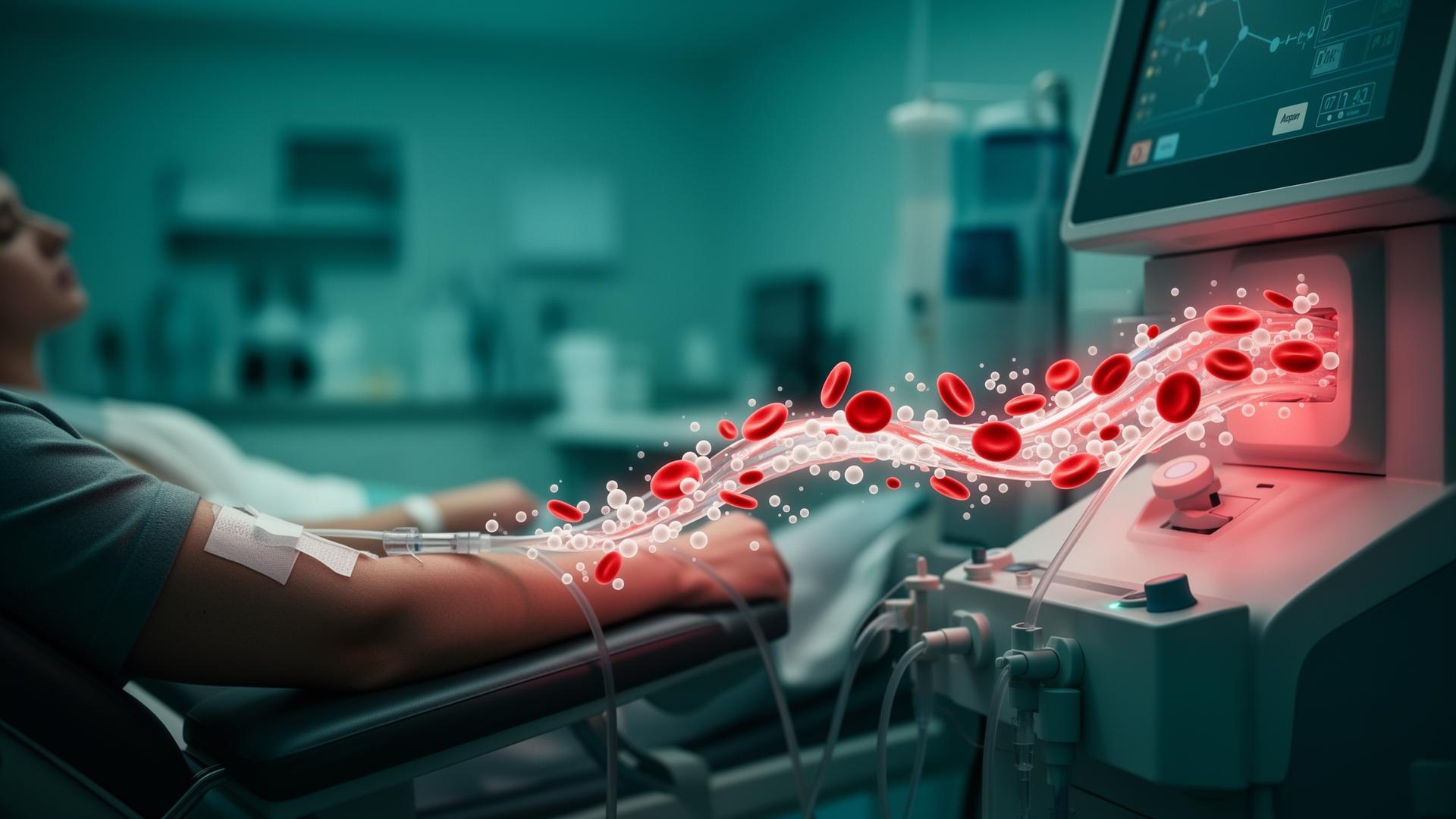
Apheresis Research Studies
Empower medical breakthroughs. Donate white blood cells through apheresis at a center and help researchers unlock the next generation of therapeutics.
A small donation. A big leap forward for medicine.
Did you know you can make a real difference by donating white blood cells? Through apheresis, a small portion of your white blood cells are separated using a sterile, FDA-cleared machine while the rest of your blood is returned to your body.
You’ll be screened to confirm study eligibility before any donation is scheduled. Our trained medical team supports you every step of the way — from your first call to your last sip of post-donation juice.
Safe & FDA-cleared
Apheresis is a routine procedure performed daily across blood centers in the US under sterile, single-use kits.
Roughly 4–5 hours
Most donations take 4–5 hours start to finish. You can read, watch a movie, or relax during collection.
Care from a clinical team
Our trained nurses and phlebotomists monitor you the entire time, before, during, and after donation.
Accelerate cures
Your white blood cells fuel research into autoimmune conditions, infectious disease, and oncology breakthroughs.
How an apheresis donation works
Four steps from sign-up to compensation.
Pre-screening
Submit a quick health profile by answering a few questions about your medical history.
Screening
Verify your eligibility instantly through the donor portal, or speak with an agent by phone if you’d prefer.
Donation
Schedule an apheresis appointment at the closest donation center.
Compensation
Earn up to $550 per eligible donation, paid via prepaid card.
Donation options & locations
48 apheresis study slots across 9 cities. Select your nearest center to view what you may qualify for.
All locations
-
Acne
-
Acromegaly
-
Acute Intermittent Porphyria (AIP)
-
Acute Lymphoblastic Leukemia (ALL)
-
Acute Myeloid Leukemia (AML)
-
Age-Related Macular Degeneration (AMD)
-
Allergy
-
Alopecia
-
Alopecia Areata
-
Alpha-Gal Syndrome (AGS)
-
Alzheimer’s Disease
-
Amyloidosis
-
Amyotrophic Lateral Sclerosis (ALS)
-
Apheresis (WBC)
Ankylosing Spondylitis
Compensation: up to $550
View Study -
Ankylosing Spondylitis
-
Anti-Myelin-Associated Glycoprotein (MAG) Neuropathy
-
Antiphospholipid Syndrome (APS)
-
Aplastic Anemia
-
Arrhythmogenic Right Ventricular Cardiomyopathy (ARVC)
-
Arthritis
-
Atherosclerosis
-
Atrial Fibrillation
-
Autoimmune Hepatitis (AIH)
-
Autoimmune Polyendocrinopathy-Candidiasis-Ectodermal Dystrophy (APECED)
-
Autosomal-Dominant Polycystic Kidney Disease (ADPKD)
-
Axial Spondyloarthritis
-
Bladder Cancer
-
Breast Cancer
-
Breast Cancer
-
Bronchiectasis
-
Cardiomyopathy
-
Apheresis (WBC)
Celiac Disease
-
Apheresis (WBC)
Celiac Disease
-
Apheresis (WBC)
Celiac Disease
-
Apheresis (WBC)
Celiac Disease
-
Apheresis (WBC)
Celiac Disease
-
Apheresis (WBC)
Celiac Disease
-
Apheresis (WBC)
Celiac Disease
-
Apheresis (WBC)
Celiac Disease
-
Apheresis (WBC)
Celiac Disease
-
Cervical Cancer
-
Chronic Inflammatory Demyelinating Polyneuropathy (CIDP)
-
Chronic Kidney Disease (CKD)
-
Chronic Lymphocytic Leukemia (CLL)
-
Chronic Myeloid Leukemia (CML)
-
Apheresis (WBC)
Chronic obstructive pulmonary disease (COPD)
Compensation: up to $550
View Study -
Chronic obstructive pulmonary disease (COPD)
-
Cirrhosis
-
Colorectal Cancer (CRC)
-
Coronary Artery Disease (CAD)
-
Covid-19 Vaccinated
-
Cryopyrin-Associated Periodic Syndrome (CAPS)
-
Cutaneous Lupus Erythematosus (CLE)
-
Cystic Fibrosis
-
Cytomegalovirus (CMV)
-
Depression/Major Depressive Disorder
-
Dermatomyositis
-
Diabetic Kidney Disease (DKD)
-
Diabetic Nephropathy
-
Diffuse Large B-Cell Lymphoma (DLBCL)
-
Discoid Lupus Erythematosus (DLE)
-
Down Syndrome
-
Dravet Syndrome
-
Duchenne Muscular Dystrophy (DMD)
-
Endometriosis
-
Eosinophilic Esophagitis (EoE)
-
Fabry Disease
-
Facioscapulohumeral Muscular Dystrophy (FSHD)
-
Fibromyalgia
-
Flu Vaccinated
-
Friedreich’s Ataxia
-
Frontotemporal dementia (FTD)
-
Gaucher’s Disease
-
Giant Cell Arteritis (GCA)
-
Gout
-
Graft-Versus-Host Disease (GVHD)
-
Granulomatosis with Polyangiitis (GPA)
-
Granulomatous Disease (CGD)
-
Graves’ Disease
-
Hashimoto’s Disease
-
Healthy
-
Heart Failure
-
Hepatitis B
-
Hepatitis C
-
Hepatocellular Carcinoma (HCC)
-
Apheresis (WBC)
Hidradenitis Suppurativa
-
Apheresis (WBC)
Hidradenitis Suppurativa
-
Apheresis (WBC)
Hidradenitis Suppurativa
-
Apheresis (WBC)
Hidradenitis Suppurativa
-
Apheresis (WBC)
Hidradenitis Suppurativa
-
Apheresis (WBC)
Hidradenitis Suppurativa
-
Apheresis (WBC)
Hidradenitis Suppurativa
-
Apheresis (WBC)
Hidradenitis Suppurativa
-
Apheresis (WBC)
Hidradenitis Suppurativa
-
Hodgkin Lymphoma
-
Human Immunodeficiency Virus (HIV)
-
Human Papillomavirus (HPV)
-
Huntington’s Disease
-
Hypercholesterolemia
-
Hypersomnia
-
Hypertension
-
Hyperthyroidism
-
Hypothyroidism
-
Idiopathic Pulmonary Fibrosis (IPF)
-
Inflammatory Bowel Disease (IBD)
-
Interstitial Lung Disease (ILD)
-
Irritable Bowel Syndrome (IBS)
-
Kidney Cancer
-
Leukemia
-
Lung Cancer
-
Lupus (SLE)
-
Lupus Nephritis
-
Lyme Disease
-
Melanoma
-
Mucopolysaccharidosis II (MPS II – Hunter syndrome)
-
Mucopolysaccharidosis III (MPS III – Sanfilippo syndrome)
-
Multifocal Motor Neuropathy (MMN)
-
Multiple Myeloma
-
Multiple Sclerosis (MS)
-
Multiple System Atrophy (MSA)
-
Muscular Dystrophy
-
Myalgic Encephalomyelitis/Chronic Fatigue Syndrome (ME/CFS)
-
Apheresis (WBC)
Myasthenia Gravis
Compensation: up to $550
View Study -
Myelodysplastic Syndrome (MDS)
-
Myeloproliferative Neoplasm (MPN)
-
Myocardial Infarction (MI)
-
Myocarditis
-
Myositis
-
Myotonic Dystrophy
-
Narcolepsy type I (NT1)
-
Neuromyelitis Optica (NMO)
-
Non-Hodgkin Lymphoma (NHL)
-
Non-Small Cell Lung Cancer (NSCLC)
-
Nonalcoholic Fatty Liver Disease (NAFLD)
-
Nonalcoholic Steatohepatitis (NASH)
-
Obesity
-
Osteoarthritis
-
Ovarian Cancer
-
Pancreatic Cancer
-
Pancreatitis
-
Parkinson’s Disease
-
Peanut Allergy
-
Pediatrics
-
Pemphigoid
-
Pemphigus
-
Pericarditis
-
Polycythemia Vera
-
Polymyalgia Rheumatica (PMR)
-
Polymyositis
-
Pompe Disease
-
Pregnant
-
Primary Biliary Cholangitis (PBC)
-
Progressive Familial Intrahepatic Cholestasis (PFIC)
-
Prostate Cancer
-
Psoriatic Arthritis
-
Pulmonary Arterial Hypertension (PAH)
-
Pulmonary Fibrosis
-
Pulmonary Hypertension
-
Relapsing-Remitting Multiple Sclerosis (RRMS)
-
Renal Cell Carcinoma (RCC)
-
Retinitis Pigmentosa
-
Apheresis (WBC)
Rheumatoid Arthritis
-
Apheresis (WBC)
Rheumatoid Arthritis
-
Apheresis (WBC)
Rheumatoid Arthritis
-
Apheresis (WBC)
Rheumatoid Arthritis
-
Apheresis (WBC)
Rheumatoid Arthritis
-
Apheresis (WBC)
Rheumatoid Arthritis
-
Apheresis (WBC)
Rheumatoid Arthritis
-
Apheresis (WBC)
Rheumatoid Arthritis
-
Apheresis (WBC)
Rheumatoid Arthritis
-
Rheumatoid Arthritis
-
Rosacea
-
Sarcoidosis
-
Sarcoma
-
Schizophrenia
-
Secondary Progressive Multiple Sclerosis (SPMS)
-
Sickle Cell Disease
-
Sickle Cell Trait (HbAS)
-
Apheresis (WBC)
Sjogren’s Disease
-
Apheresis (WBC)
Sjogren’s Disease
-
Apheresis (WBC)
Sjogren’s Disease
-
Apheresis (WBC)
Sjogren’s Disease
-
Apheresis (WBC)
Sjogren’s Disease
-
Apheresis (WBC)
Sjogren’s Disease
-
Apheresis (WBC)
Sjogren’s Disease
-
Apheresis (WBC)
Sjogren’s Disease
-
Apheresis (WBC)
Sjogren’s Disease
-
Skin Cancer
-
Sleep Apnea
-
Solid Tumor Cancer
-
Stargardt Disease
-
Tay-Sachs Disease
-
Thyroid Eye Disease
-
Transthyretin Amyloidosis (ATTR)
-
Type 1 Diabetes
-
Apheresis (WBC)
Ulcerative Colitis
-
Apheresis (WBC)
Ulcerative Colitis
-
Apheresis (WBC)
Ulcerative Colitis
-
Apheresis (WBC)
Ulcerative Colitis
-
Apheresis (WBC)
Ulcerative Colitis
-
Apheresis (WBC)
Ulcerative Colitis
-
Apheresis (WBC)
Ulcerative Colitis
-
Apheresis (WBC)
Ulcerative Colitis
-
Apheresis (WBC)
Ulcerative Colitis
-
Vasculitis
-
Vitiligo
-
Wilson’s Disease
Apheresis FAQs
Common questions about donating white blood cells with Sanguine.
What is apheresis?
Apheresis is a blood collection method that separates a single component — in this case white blood cells — and returns the rest of your blood (red cells, plasma, platelets) to your body. Blood is drawn from one arm, processed by a sterile single-use machine, and returned through the other arm.
How long does a donation take?
Plan for 4–5 hours total at the donation center, including check-in, vitals, the apheresis collection itself (about 90 minutes), and post-donation rest.
What is the compensation?
Eligible donors are compensated up to $550 per donation, depending on the study.
Is the procedure safe?
Yes. Apheresis is FDA-cleared and performed worldwide every day. All equipment is sterile and single-use. A licensed clinical team monitors you throughout the donation.
How often can I donate?
Most eligible donors can return every 2–4 weeks. Your coordinator will confirm the cadence specific to your study and health profile.
Will my insurance be billed?
No. Apheresis research donations are never billed to your insurance. Sanguine covers all costs related to the donation.
Ready to donate and accelerate research?
Sign up in minutes. A coordinator will reach out within 48 hours to confirm eligibility and schedule your first apheresis appointment.